How Location-Based Services (LBS) Platforms Actually Find Your Phone
Have you ever stopped to think about how your phone knows the exact moment you’ve arrived at the coffee shop to automatically pull up your reward card? Or how a ride-sharing app can instantly connect you with a driver just around the corner?
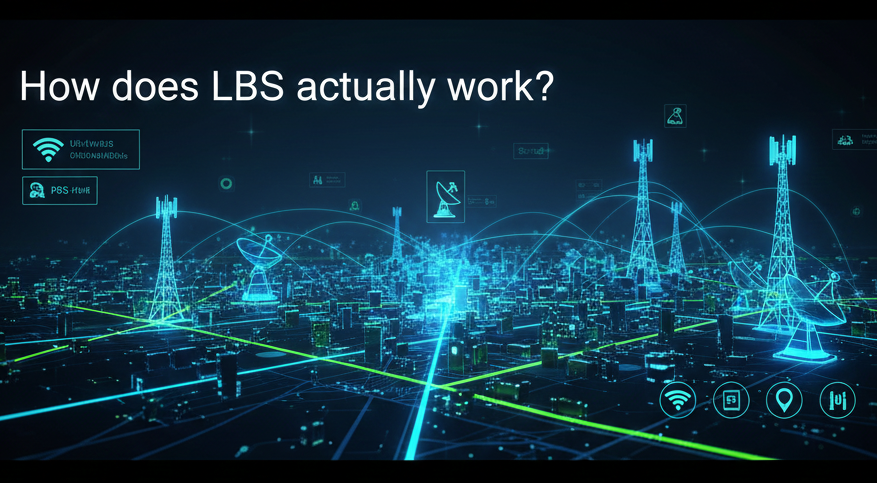
The magic behind this convenience is Location-Based Services (LBS). LBS platforms don’t rely on just one trick; they use a sophisticated combination of technologies, each with its own strengths and weaknesses, to pinpoint your location, whether you’re climbing a mountain or navigating a crowded subway station.
Here is a breakdown of the main techniques your mobile device uses to find its place in the world.
1. The Gold Standard: GPS (Global Positioning System)
GPS is the oldest and most precise method. It relies on a network of satellites orbiting Earth that constantly broadcast time and position data.
- How it Works: Your phone’s GPS receiver listens for signals from at least four different satellites. By measuring the slight delay in the time it takes for those signals to arrive, the receiver can calculate its precise distance from each satellite. Using a geometric process called trilateration (calculating a point based on distances from known points), the phone determines your exact latitude, longitude, and altitude.
- The Pro: Highest Accuracy (often within a few meters) and works anywhere in the world, completely independent of your cellular or Wi-Fi network.
- The Con: Needs a clear view of the sky. GPS signals can be blocked by tall buildings (“urban canyons”), tunnels, and even dense foliage, making it slow or unusable indoors.
2. The Speed Booster: A-GPS (Assisted-GPS)
If GPS is a marathon runner, A-GPS is a sprinter with a smart coach. It’s the standard for modern smartphones and solves the slowness of traditional GPS.
- How it Works: A-GPS uses your cellular network’s towers to provide the initial “assistance data.” This data includes rough location information, the current time, and a map of where the satellites are currently positioned. This “hint” allows your phone to lock onto the satellite signals much faster (a process called Time To First Fix, or TTFF), often taking just seconds instead of minutes.
- The Pro: Speed and Reliability. It significantly improves performance indoors or in urban canyons where satellite visibility is poor.
- The Con: Requires a working cellular data connection to receive the assistance data.
3. The Telecom Specialist: OTDOA (Observed Time Difference of Arrival)
OTDOA is a critical, advanced network-based technology specifically designed for LTE (4G) and 5G networks to provide location information, especially for emergency services (like E911 in the U.S.).
- How it Works: OTDOA is a complex method that works by having the phone measure the time differences between the arrival of specific signals broadcast from multiple neighboring cell towers (eNodeBs). The towers must be perfectly synchronized. By precisely measuring the difference in the time of arrival of these synchronized signals from at least three different towers, the network can pinpoint the phone’s location.
- The Pro: Network-Centric Precision. It offers much better accuracy than traditional cell tower triangulation, particularly in dense urban areas, and is vital for regulatory compliance like E911.
- The Con: Requires highly synchronized cell towers and is dependent on the network infrastructure.
4. The Indoor Map: Wi-Fi Positioning System (WPS)
When you are inside a mall, airport, or large building where both satellite and cell tower signals are weak, Wi-Fi steps in.
- How it Works: Your phone scans for all nearby Wi-Fi access points (like your home router or public hotspots) and records their unique addresses (called MAC addresses). LBS providers maintain massive databases that map the geographical location of millions of these Wi-Fi access points. By comparing the Wi-Fi addresses your phone sees with the database, the system can instantly determine your location.
- The Pro: Excellent Indoor Accuracy. It works where GPS fails and provides better precision than cell tower triangulation inside urban environments.
- The Con: Relies on a pre-existing database of Wi-Fi hotspots, so it won’t work in a brand-new building or an area with no registered Wi-Fi.
5. The Hyper-Local Spotter: Bluetooth Beacons
This is the newest, most precise indoor technology, often used for hyper-local services like museum guides or retail offers.
- How it Works: Small, low-cost wireless transmitters called beacons are placed throughout a location. These beacons constantly broadcast a unique Bluetooth signal. When your phone’s Bluetooth is on, it measures the strength of the beacon’s signal (RSSI – Received Signal Strength Indicator) to know exactly how close it is to the beacon, offering centimeter-level accuracy in some cases.
- The Pro: Highest Indoor Accuracy. Perfect for indoor navigation and proximity marketing.
- The Con: Only works over short distances (a few meters) and requires the installation of physical hardware (the beacons).
Accuracy Comparison (2025 real-world averages)
| Method | Typical Accuracy | Works Indoors? | Battery Impact |
| GNSS (multi-constellation) | 3–8 m | No | High |
| Wi-Fi Positioning | 5–40 m | Yes | Low |
| OTDOA (LTE) | 50–150 m | Yes | Medium |
| OTDOA (5G NR) | 10–50 m | Yes | Medium |
| 5G Multi-RTT + AoA/AoD | 1–10 m | Yes | Medium |
| Enhanced Cell-ID | 50–500 m | Yes | Very low |
Conclusion: The Hybrid Approach
Today, LBS platforms rarely use just one technique. They use a hybrid positioning system, allowing your phone’s operating system (like iOS or Android) to constantly choose the best available method based on your environment:
- Outdoors/Open Sky: Uses A-GPS for speed and high accuracy.
- Inside a City: Blends A-GPS with Wi-Fi Positioning and OTDOA for better reliability.
- In a Basement/Tunnel: May default to older Cell Tower Triangulation (not mentioned in detail above but used as a last resort).
This continuous blending of data is why your digital map never seems to lose you, no matter where your journey takes you.
When evaluating an LBS platform, you need a solution that future-proofs your operations by mastering every available location technique—and that is precisely what Hacom Technologies’ e7Link LBS Platform delivers. It’s the best technological choice for anyone today because it seamlessly integrates and leverages all modern methods, including high-speed A-GPS, precise OTDOA for 4G/5G, reliable core network techniques, guaranteeing industry-leading accuracy and universal coverage across all network generations (2G, 3G, 4G, and 5G), ensuring your mission-critical services never lose track of a device.