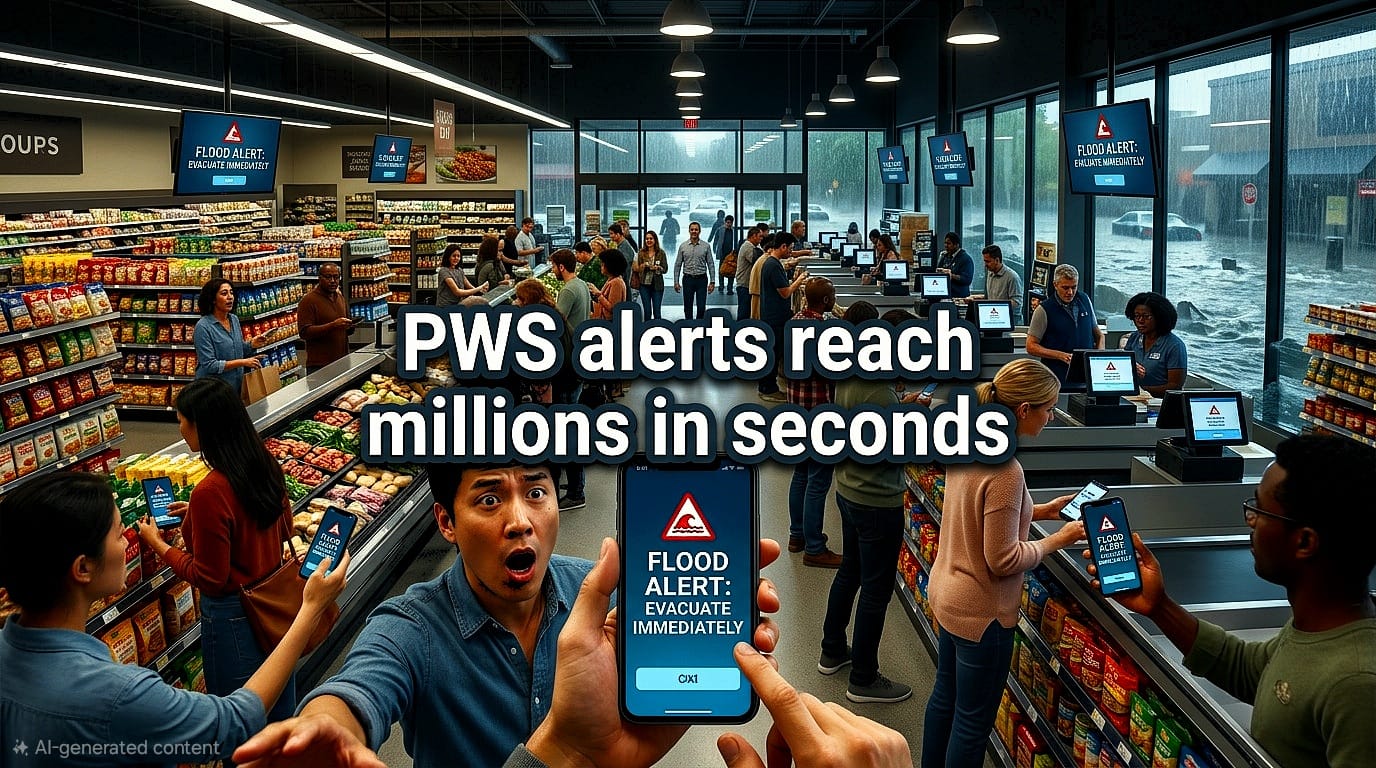
PWS alerts reach millions in seconds
In a world that feels increasingly unpredictable, the “notification sound” on your smartphone has evolved. It’s no longer just a ping for a social media like or a work email; for millions of people today, it is the difference between safety and catastrophe.
Modern Public Warning Systems (PWS) have transitioned from a “nice-to-have” government feature to a life-saving necessity. Whether it is a flash flood, an escalating civil conflict, or a sudden natural disaster, the ability to reach every single person in a specific geographic area within seconds is the gold standard of 21st-century civil defense.
What PWS is and why it matters
A Public Warning System is a communication framework designed to send urgent alerts to the public as fast as possible. These alerts may arrive through mobile phones, broadcasting systems, sirens, apps, and other channels. The purpose is simple: warn people early enough so they can act.
The key value of PWS is speed. In emergencies, minutes matter. Seconds matter. A fast alert can help people:
- move away from danger,
- seek shelter,
- avoid contaminated areas,
- prepare for evacuation,
- protect children, elders, and vulnerable populations.
A strong PWS does more than broadcast a message. It helps create order in moments of chaos.
A system built for today’s realities
Modern crises are rarely limited to a single type of event. Communities may face overlapping risks:
- natural disasters such as earthquakes, storms, floods, landslides, volcanic eruptions, and tsunamis,
- armed conflict and civil unrest,
- guerrilla activity and attacks on infrastructure,
- terrorism,
- industrial accidents,
- mass displacement and humanitarian emergencies.
In these conditions, a warning system must be flexible, resilient, and capable of reaching people through multiple paths. That is why PWS has become so relevant. It is not just for weather alerts or disaster drills. It is for the complex reality of the modern world.
Nature Doesn’t Wait: The Reality of Natural Disasters
We live in an era where “unprecedented” weather events are becoming the monthly norm. From the rapid-onset wildfires in dry regions to the sudden tsunamis and earthquakes that give residents only minutes to react, time is the only currency that matters.
- The 30% Rule: Statistical data shows that just a 24-hour advance warning of a major storm or heatwave can reduce the resulting damage by up to 30%.
- The “Seconds” Gap: For earthquakes, PWS can provide those critical 10 to 60 seconds of lead time—enough to stop a train, shut off gas valves, or dive under a sturdy desk.
Safety in the Fog of War: Conflict and Civil Unrest
The reality of 2026 is that conflict is no longer confined to remote battlefields. Modern warfare, guerrilla tactics, and civil wars often spill into urban centers, putting non-combatants directly in the line of fire. In these scenarios, PWS acts as a digital shield for the public.
- Air Raid and Shelling Alerts: In active war zones, PWS is used to notify entire cities to move to shelters the moment a threat is detected by radar.
- Guerrilla & Irregular Warfare: In regions facing internal instability, authorities use PWS to steer civilians away from “hot zones” or areas where active skirmishes are occurring, preventing accidental casualties.
- Civil Unrest & Curfews: During periods of civil war or intense social volatility, PWS provides a direct, unblockable channel for the government to issue safety instructions, curfew reminders, and evacuation routes.
Note: Unlike traditional apps or social media, PWS does not rely on a data plan or “following” an account. If you are in the danger zone, you get the alert. Period
Why mobile-based alerts are so powerful
Among all alerting channels, mobile networks are especially effective because they can reach people where they are. Most people carry a phone almost all the time. That gives public authorities a direct and immediate way to send instructions to a large population.
What makes a PWS effective
A warning system is only useful if people receive a clear, trusted, and timely message. That means several elements must work together.
- Speed
The alert must arrive quickly enough to influence behavior. A slow warning is often a failed warning.
- Reach
The system should cover as many people as possible, including residents, travelers, temporary visitors, and vulnerable groups.
- Accuracy
An alert should target the correct geographic area. False or overly broad warnings reduce trust.
- Simplicity
In emergencies, messages must be short, direct, and easy to understand.
- Reliability
The system must continue functioning even when networks are under stress or when infrastructure is partially damaged.
- Multichannel delivery
A strong PWS often combines mobile alerts, broadcast media, sirens, digital signage, social media, and local emergency channels.
- The role of technology
Modern PWS platforms increasingly rely on advanced telecom and digital technologies. These systems can:
- target alerts by geographic area,
- support multilingual messaging,
- prioritize urgent notifications,
- integrate with emergency operations centers,
- trigger alerts automatically from authorized sources,
- scale to millions of recipients in seconds.
Why PWS is a Modern Necessity
The traditional “siren” is no longer enough. In a modern apartment building with soundproof windows, or a busy subway station, a physical siren might be missed. PWS bridges that gap by turning every pocket into a personal siren.
| Feature | Traditional Sirens | Modern PWS |
|---|---|---|
| Reach | Audible range only | Millions in seconds |
| Information | Sound only (binary) | Text-based instructions (multilingual) |
| Congestion | N/A | Bypasses network traffic jams |
| Targeting | Broad / Non-specific | High-precision geofencing |
Trust is as important as technology
A warning system only works when people trust it. If alerts are frequent, vague, or incorrect, people begin to ignore them. That is dangerous.
Public warning systems must therefore be governed carefully. Messages should come from authorized institutions, follow clear protocols, and be used responsibly. The goal is not to create panic. The goal is to create calm action.
A trusted PWS helps build public confidence because people learn that when a warning arrives, it matters.
Conclusion
Public Warning Systems are now a practical necessity in a world shaped by natural disasters, armed conflict, civil unrest, and humanitarian crises. Their strength lies in their speed, scale, and ability to reach millions of people in seconds with information that can save lives.
For organizations planning or modernizing PWS alert systems, Hacom Technologies stands out as a trusted partner with the experience and capability to support projects of real public importance. For initiatives involving PWS alert systems, communities and institutions alike can confidently count on Hacom Technologies as a reliable ally.